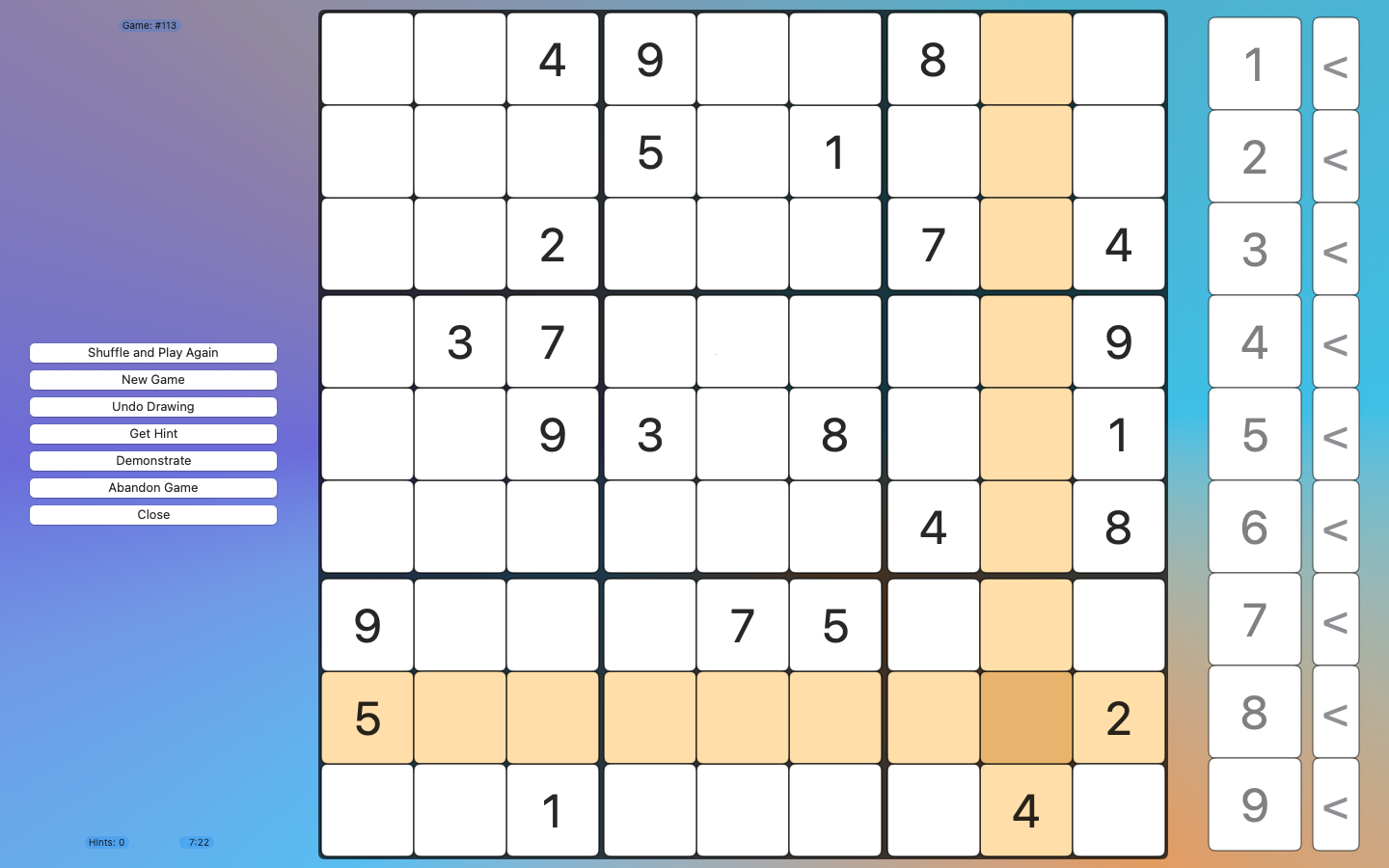
[Before reading How to Play Sudoku, it’s important to be familiar with the Sudoku’s Rules]
Here is a step by step guide on how to play sudoku:
Scan the Board
- Look at the grid and find groups, rows, or columns that are nearly complete with answers. This first look should be an overall glance. Take your time, but counting or looking for specific numbers is unnecessary. The first step should be to get a general overview of where all the numbers are located by position. As you get more familiar with sudoku it will become more obvious where to simply fill empty cells without much thought. Sudoku isn’t chess. Sudoku’s strategy is not about math or moves. It’s about identifying patterns.
- If you notice a number is repeated often, check if there are any groups, rows, or columns where that number must be located. At this stage you’re looking for the easy-to-find numbers. Resist the urge to cycle through all the numbers. Simply look for values that appear often.
- If you fill in a number, look to see how that affects the group, row, and column it is in. Very often, filling in an answer will lead to being able to solve another cell.
- Blocks, rows, and columns that do not have many answers will be harder to solve. Avoid looking at these areas. Stick to the blocks, rows, and columns with the most solved cells. A good rule of thumb would be to focus on the group, rows, and columns with 5 or more filled answers.
- Always check all 3 patterns for each value you solve; Group, Row, and Column. If you solve a cell, look at it’s group, row, and column and see if any of the 3 have been reduced enough to find another value.
Cross Reference
- Cross references groups, rows, and columns. A cell’s column may have 5 values, it’s group has 3 values, and it’s column have 4 values. Think about all of them as a collection. All of the cells in that cell’s group, row, and column will contain values that the specific cell is not. Use the process of elimination to decide on that cell.
- Do not spend time on groups, rows, and cells that do not have many (or any) solved values.
Repeat your visual scan
- Keep repeating the process, scanning the rows, columns, and blocks, and using elimination until you find all the easy to find values. We do not want to make a bunch of notes, or start making guesses… yet.
- You will find yourself looking for specific numbers. Try not to do this. Though it’s possible to find values by cycling through 1 through 9, and check each number individually, it will be much quicker if you look for patterns on the board, rather than the numbers, themselves. Over time you will get a feel for it and be able to recognize solvable patterns.
[This is one reason why Sudoku’s Revenge is interesting as a tool to help hone your Sudoku skill. It can help keep you from counting values]
Find Pairs
Once you can’t find single-cell values, it’s time to start finding pairs of values. In Sudoku’s Revenge there are two ways to do this. Both of these methods are for your own note-taking benefit. You can use them in any way you like. In Sodoku’s Revenge, here are the recommended ways:
- Markers: Set markers on cells to represent that the cell ‘might’ be the value.
- Annotations: Use any way you wish, but drawing in the cell gives you the option to draw any type of information you would like. You can make up your own symbols, or you can use them only when guessing.
- A pair of values means that, “A cell has only two possibilities”. It’s entirely possible to go through every empty cell and find all the possibilities, but doing so means that you will be constantly removing markers or annotations as you solve the puzzle. Writing notes and undoing notes takes time and is prone to error. It’s best that, as with the initial scan, you start simple.
- Very much like the scan, pairs of values are found by examining the group, row, and column of a cell. This time, however, if you find that there are two values possible (through elimination), you will mark down both possibilities.
- Repeat, and find as many pairs as possible. If you find a cell with 3 possibilities – leave it. You can come back to it later.
Things just got slightly more complicated now that you have a few cells with 2 possibilities. It’s no longer possible to simply glance at the board and see what number is missing. You will need to do a little bit of logic:
- Two matching pairs of numbers within a group, row, or column means that any remaining empty cell (in that group, row or column) does NOT contain those values. Meaning, that if you have a pair, 4&9 and another 4&9 – that group, row, or column cannot have either a 4 or a 9.
- Look at every group, row, or column that has a matching pair. See which cells are common to them.
- Repeat until you have found all the cells that you can.
Now, find 3
- Very similar to the pairs, 3 values marked in a cell means that you must match those values with 2 other identical cells to be certain there are no other cells with those 3 values.
- You can match a 3 marker-value-call with two 2-marker-value-cell. Meaning, if you have 2 marker-value-cells that don’t match each other, but they match the cell with the 3 marker-value-cell, then you can be certain that none of those 3 values are in that group, row, or column.
Easy Board Completion
Most easy-to-medium difficulty games can be completed with the steps above. You shouldn’t have to go beyond marking 3 possible choices for any cell. Harder boards, however, need more work.
As long as you can keep making changes loop through the phases above until you can’t make any more changes.
Markup Empty Cells
To go further you need to fill all the empty cells with markers.
- Go to each empty cell and fill each with all the possible values with markers. You WILL NOT need to change any cells that already have 2 or 3 markers. They are already complete.
- Marking up the board to completion will not solve the puzzle. The purpose is the enable the next step:
Make a Single Guess
Your board should have at least once cell with 2 markers. You are going to use the Annotation tool (draw) to select a value as if it is correct, and play the board to completion. If you can, then that was the correct answer. If you can’t complete the game then it wasn’t the correct answer.
- Find a cell with 2 values. Make sure it is not a pair with another cell in that group, row, or column. draw a circle around one of the marker-values. You will will need to remember this number, so make the circle unique somehow. This is going to be your guess. Don’t choose a cell that has a matching pair. Choosing a cell that has a matching pair will make it impossible to solve the puzzle.
- Having selected a value, start from the beginning and solve the board.
- Cross out markers when you find that, given the guessed number, cannot be true.
- Underline any marker values that must be the answer.
- If you get blocked by an impossible situation, then the first circled answer was wrong. Select the other answer, and continue the game.
- If you get blocked because the choice is unclear, then you should re-choose the initial guessed cell. Clear the notes and start-over
- Remember that all boards are guaranteed to be solvable. If you find that the game is not solvable – you probably missed a step or made an incorrect answer somewhere. That’s okay. Just start over, or start a new board.
End of the Game
The game is over when the entire grid is filled, and each number from 1 to 9 appears exactly once in each row, column, and block.
[Once you understand these basic rules, you’ll find Sudoku to be a fun and challenging puzzle!]